

The Age-Old Question
Before every draft comes the picking of the draft order. Maybe your league has an annual ‘guess how many jelly beans are in the jar’ competition. Or perhaps your commissioner, the real unsung heroes of fantasy football, spends $20 on Cameo to have the excitement of someone determining and announcing your draft order, like it’s the lottery. You could be a league that randomizes it an hour before the draft begins. Everyone has their preferred spots in the draft order. Some people want the glory and pressure that come with 1st overall. Others like a middle-of-the-pack pick, never having to wait too long between their pick. But does it matter where you pick? Do your odds of winning it all get affected by the order?
In this semi-serious, semi-deep dive, I attempt to answer that question. What draft pick has the best chance of winning your league?
Before I go too deep into my data, let’s look at my parameters. I looked into 10-Team & 12-Team snake drafts for this experiment with 0.5 PPR scoring, the standard scoring used for all of my articles and for the QBList Podcast hosted by Brian Hartman (@TooMuch_Brian) and me. I focused solely on a team’s seven starters: QB, RB, RB, WR, WR, TE, and a Flex (RB/WR/TE). In my draft attempts, every team took the best player available according to ADP at a position of need. For example, once a team has a quarterback, that team will not draft another, regardless of how good the value is. Same with the other positions; if a team has 3 RBs (2 RBs and one for their Flex), they will not draft another RB and will exclusively target unfilled positions in their roster. After the draft, I looked at each player’s projected Fantasy Points for the season, added them up, and ranked the teams by their players’ total. Obviously, this has some flaws. I don’t think a single fantasy draft in the history of sports has gone entirely in order of ADP. Let’s use our imagination here. Second, what about benches, byes, injuries, unexpected booms and busts? I cannot predict these things. Byes, yes, but with everything else comes the variation for why we play. They’re the thrill of the game. So for this experiment, we’re playing with injuries off.
With all that out of the way, let’s look at the teams and their scores.
Let’s start with the 10-Team league.
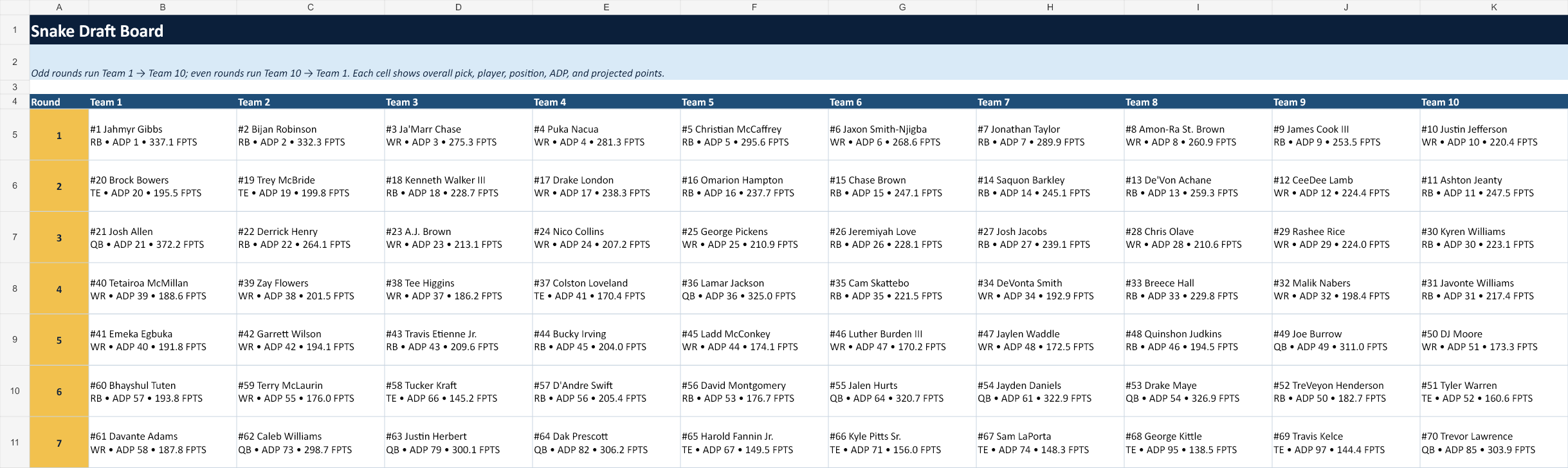
2026 Fantasy Football — 10-Team Snake Draft Summary
| Team | QB | RB1 | RB2 | WR1 | WR2 | TE | Flex | Total FPTS |
|---|---|---|---|---|---|---|---|---|
| Team 1 | Josh Allen | Jahmyr Gibbs | Bhayshul Tuten | Tetairoa McMillan | Emeka Egbuka | Brock Bowers | Davante Adams | 1666.8 |
| Team 2 | Caleb Williams | Bijan Robinson | Derrick Henry | Zay Flowers | Garrett Wilson | Trey McBride | Terry McLaurin | 1666.5 |
| Team 3 | Justin Herbert | Kenneth Walker III | Travis Etienne Jr. | Ja’Marr Chase | A.J. Brown | Tucker Kraft | Tee Higgins | 1558.2 |
| Team 4 | Dak Prescott | Bucky Irving | D’Andre Swift | Puka Nacua | Drake London | Colston Loveland | Nico Collins | 1612.8 |
| Team 5 | Lamar Jackson | Christian McCaffrey | Omarion Hampton | George Pickens | Ladd McConkey | Harold Fannin Jr. | David Montgomery | 1569.5 |
| Team 6 | Jalen Hurts | Chase Brown | Jeremiyah Love | Jaxon Smith-Njigba | Luther Burden III | Kyle Pitts Sr. | Cam Skattebo | 1612.2 |
| Team 7 | Jayden Daniels | Jonathan Taylor | Saquon Barkley | DeVonta Smith | Jaylen Waddle | Sam LaPorta | Josh Jacobs | 1610.7 |
| Team 8 | Drake Maye | De’Von Achane | Breece Hall | Amon-Ra St. Brown | Chris Olave | George Kittle | Quinshon Judkins | 1620.5 |
| Team 9 | Joe Burrow | James Cook III | TreVeyon Henderson | CeeDee Lamb | Rashee Rice | Travis Kelce | Malik Nabers | 1538.4 |
| Team 10 | Trevor Lawrence | Ashton Jeanty | Kyren Williams | Justin Jefferson | DJ Moore | Tyler Warren | Javonte Williams | 1546.2 |
Some things that stand out to me. Team 1 takes a TE and a QB at the 2/3 turn, an interesting, uncommon strategy. Team 4 is the only team to go WR, WR, WR in the first three rounds, while Team 7 is the only team that went RB, RB, RB. Round 7 was the round of TEs and QBs for all teams except Team 1. Seven TEs and seven QBs were taken in the final two rounds. That feels expected; if you don’t get a stud at the top of the draft, you’re likely to wait until the end for those positions. Team 4 was the first team to not draft according to ADP and instead draft for positional need. In Round 4, they drafted Colston Loveland over Tee Higgins since they already had three WRs on their roster. Teams 8 & 9 were punished the harshest by position of need over ADP, both forced to take TEs with an ADP in the high-90s late in the draft, while Team 1 got Davante Adams, who has an ADP of 58. Looking at the scores, Teams 1 & 2 were neck and neck and well above the rest of the pack. Team 1 finished with the top score by just a third of a point! Teams 9 & 10 were both at the bottom of the league, but surprisingly, Team 8 finished with the third-most points.
Let’s check out the 12-Team league.
Click the image for the full-sized Draft Board
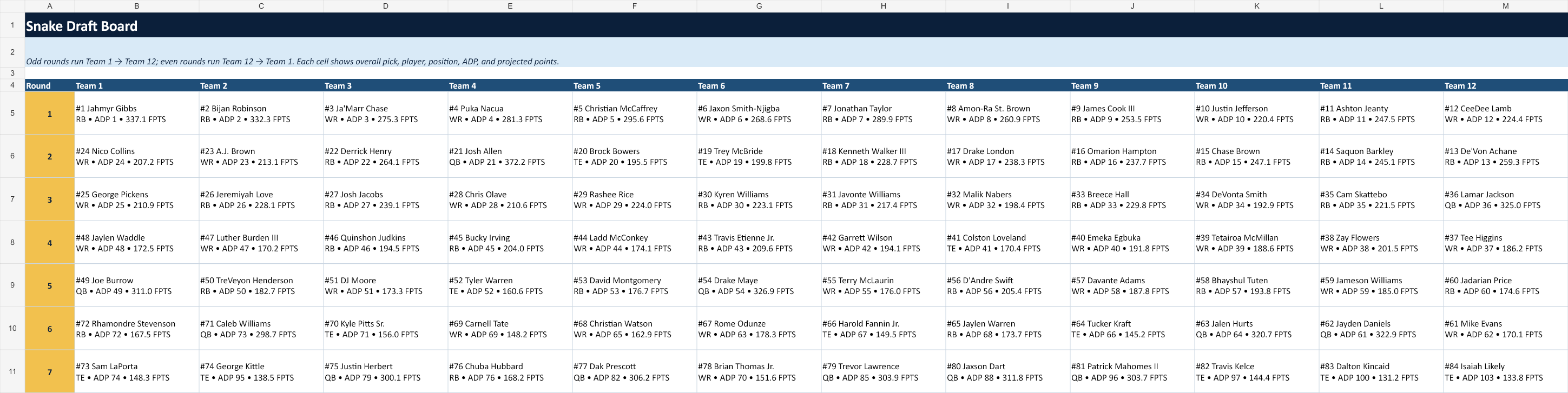
2026 Fantasy Football — 12-Team Snake Draft Summary
| Team | QB | RB1 | RB2 | WR1 | WR2 | TE | Flex | Total FPTS |
|---|---|---|---|---|---|---|---|---|
| Team 1 | Joe Burrow | Jahmyr Gibbs | Rhamondre Stevenson | Nico Collins | George Pickens | Sam LaPorta | Jaylen Waddle | 1554.5 |
| Team 2 | Caleb Williams | Bijan Robinson | Jeremiyah Love | A.J. Brown | Luther Burden III | George Kittle | TreVeyon Henderson | 1563.6 |
| Team 3 | Justin Herbert | Derrick Henry | Josh Jacobs | Ja’Marr Chase | DJ Moore | Kyle Pitts Sr. | Quinshon Judkins | 1602.4 |
| Team 4 | Josh Allen | Bucky Irving | Chuba Hubbard | Puka Nacua | Chris Olave | Tyler Warren | Carnell Tate | 1545.1 |
| Team 5 | Dak Prescott | Christian McCaffrey | David Montgomery | Rashee Rice | Ladd McConkey | Brock Bowers | Christian Watson | 1535.0 |
| Team 6 | Drake Maye | Kyren Williams | Travis Etienne Jr. | Jaxon Smith-Njigba | Rome Odunze | Trey McBride | Brian Thomas Jr. | 1557.9 |
| Team 7 | Trevor Lawrence | Jonathan Taylor | Kenneth Walker III | Garrett Wilson | Terry McLaurin | Harold Fannin Jr. | Javonte Williams | 1559.5 |
| Team 8 | Jaxson Dart | D’Andre Swift | Jaylen Warren | Amon-Ra St. Brown | Drake London | Colston Loveland | Malik Nabers | 1558.9 |
| Team 9 | Patrick Mahomes II | James Cook III | Omarion Hampton | Emeka Egbuka | Davante Adams | Tucker Kraft | Breece Hall | 1549.5 |
| Team 10 | Jalen Hurts | Chase Brown | Bhayshul Tuten | Justin Jefferson | DeVonta Smith | Travis Kelce | Tetairoa McMillan | 1507.9 |
| Team 11 | Jayden Daniels | Ashton Jeanty | Saquon Barkley | Zay Flowers | Jameson Williams | Dalton Kincaid | Cam Skattebo | 1554.7 |
| Team 12 | Lamar Jackson | De’Von Achane | Jadarian Price | CeeDee Lamb | Tee Higgins | Isaiah Likely | Mike Evans | 1473.4 |
The 12-Team draft exactly matched ADP for the first 56 picks, before 58 and 57 swapped order. Round 6 saw some more deviation from ADP, while Round 7 is where chaos began. QBs and TEs forced players in the 90s and even triple digits to be drafted, while some players in the 70s remained on the board. Again, Team 7 went RB, RB, RB, though they were joined by Teams 9 & 11 this time. Team 8 was the only team to go WR, WR, WR. Looking at the total points, again the front of the draft was favored. Team 3 had nearly 40 points more than second-place Team 2. Teams 7, 8, & 6 were separated by less than two points. The team that drafted last finished with the fewest points, over 30 points behind Team 10.
So what did we learn? In this snapshot of a draft with very constricted rosters, no matchups, no byes, no injuries, drafting early matters. Teams drafting in the top three finished in the top two in both formats. Drafting near the end but not exactly at the end was also favorable, especially in the larger format.
The biggest takeaway: don’t reach for positional need. Taking a QB or TE with near triple-digit ADP to fill out your starters is not worth sacrificing players with greater value still on the board. You can never have too many RBs or WRs.
That’s a wrap on this one. Sound off in the comments if you like this pseudo-science breakdown as a change-up of all the standard analysis we put out there. As always, you can find me on Twitter @marioadamojr and weekly on the QBList Podcast.
Adapted by Kurt Wasemiller (@kurt_player02 on Instagram & Threads | @kuwasemiller.bksy.social on BlueSky)